Did you happen to record Monty Python’s Flying Circus when it was shown on PBS back in the 1970s?
Do you still have the tapes?
Is there a TIME LIFE logo at the end?
If so, please write to me.
Thank you!
Joris
Ivens, the famous experimental Dutch filmmaker, spent his life traveling the world
making documentaries. All are rare, and this is one of the rarest. I have seen only
two Ivens films, The Bridge and Rain, both silent experimental shorts,
and there is no question to my mind that Ivens’s impressionistic editing left a
mark on Brass. According to Carlos Böker’s thesis, Joris Ivens, Film-Maker:
Facing Reality (“Studies in Photography and Cinematography, No. 1,”
UMI Research Press, 1978):
... Ivens was approached by
Enrico Mattei, head of ENI, the Italian
State Natural Gas Monopoly. Mattei, who died
mysteriously in an air crash in 1962, and
was the subject of a later film by Francesco
Rosi (Il caso Mattei, The Mattei
Affair, 1972), had been put in charge of
ENI on the understanding that he would wind
it up. However, he expanded its activities
and investment programme against much
internal political opposition and external
opposition from the US-controlled
multinational oil firms. Ivens’s films,
collectively entitled Italia non è
un Paese povero, were to be shown on
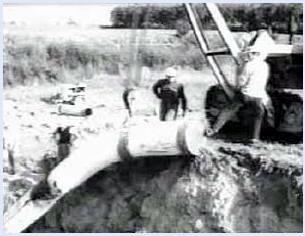
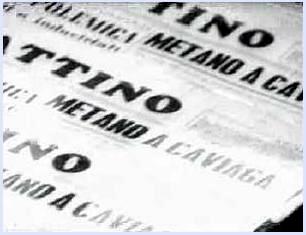
television. The first part, Fuochi della
Val Padana (Fire in the Po
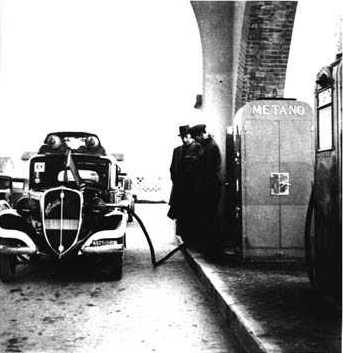
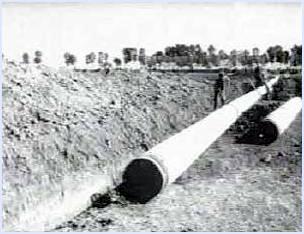
Valley), deals with the extraction and
distribution of methane in the Po Valley.
The second part is divided in two: Due
città (Two Cities), devoted
to Venice (Porto Maghera) and Ravenna, is a
treatment of the production of agipgaz and
its by-products; and La storia di due
alberi (The Story of Two Trees),
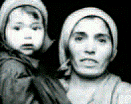
set in Lucania, which contrasts the
impoverishment of peasant life in a southern
village, where seven families are dependent
on one olive tree, with the future benefits
to come through the newly exploited natural
resource (mechanisms for controlling the gas
outlets, lit up at night, are called
“Christmas trees”).
The third part, Appuntamento
a Gela (An Appointment in Gela),
is set in Sicily, and revolves around the
marriage of a Sicilian, daughter of a
fisherman, to a North Italian worker on an
oil rig offshore. By the time the film was
finished, Mattei was in a weak political
position, and RAI-TV refused to show the
films as they were, taking particular
exception to the representation of peasant
life in Lucania as being irrelevant to the
main subject. From being three programmes
each 45 minutes long, the film was cut down
[by 25 minutes] and was shown, at
Ivens’s insistence, under the general
description “Fragments of a film by
Joris Ivens.” He left the country
secretly taking a complete copy with him,
and this original version had its first
showing at an Ivens retrospective in Modena
in 1979.
(Actually, he left the country without taking a complete
copy with him. But once he realized what was happening to his film, he telephoned Tinto
Brass and told him where he could steal the original version, and asked him to smuggle it
out of Italy. Brass did, but no one said a word about this until long past the expiration of
the statute of limitations. This story demonstrates, once again, that it is to thieves that
we owe so much of the preservation of our history.)
Many of the younger generation
of Italian directors worked with Ivens on
the making of Italia non è un Paese
povero, including the Taviani brothers
(Paolo and Vittorio, whose main success in
England has been Padre Padrone,
1977), Valentino Orsini and Tinto Brass. A
feature of the film is the consistent fun
which is poked at TV documentary methods, in
particular the technique of on-the-spot
interviews.
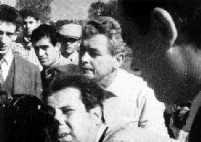
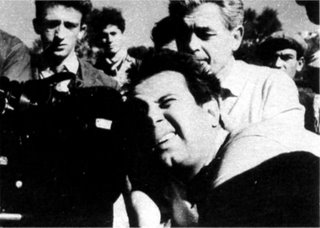
Brass at the camera, Ivens behind him.
We are
offering a bounty for a good copy of L’Italia non è
un Paese povero. If you know where we can
get one, write to us.
It was filmed in 1959 and broadcast only once, in 1960. There are
a few vague indications that it was also shown in France under
the title L’Italie n’est pas un pay pauvre, but
we haven’t been able to confirm this. The cut
version seems to be available for rental in 35mm from
the Ivens Foundation. The original uncut version has
since been revived for a single showing at the Cannes
trade festival of 2000, with Tinto Brass introducing
it in person. In 1997 documentarian Stefano Missio
made a 43-minute black-and-white follow-up, Quando
l’Italia non èra un Paese povero. For
more information, see: