|
“THE RETURN OF ROSSELLINI”
Roberto Rossellini, who not long ago was
artistically, commercially and in the hearts
of his countrymen (and elsewhere) as solid
as an overdone strand of linguini, is
shooting back into the film firmament like a
Roman candle.
After he made
“Stromboli” and a few other
bombolis, and after l’affaire Bergman,
the press and the public weren’t even
saying “arrivederci”; they were
giving him the old gladiatorial thumbs-down.
Now, his two latest pictures are
award-winners and he has a rosy horizon
full of prospects.
Last Spring at the Venice Film
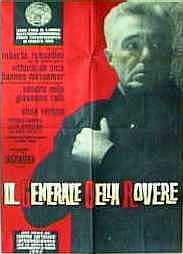
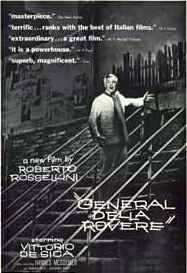
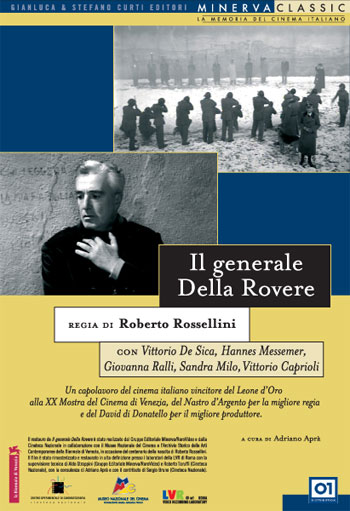
Festival, Rossellini’s “General
della Rovere”, which has its premiere
here on .......... at the ..........
Theatre, won first prize as the best picture
of the year. The International Film Critics
awarded the film their top prize, and it
received five — that’s right,
cinque — awards at the 1959 San Francisco
film summit meeting — including one for
the best direction.
On November 1st, this year,
Rossellini’s “Night Over
Rome” won two prizes at the fourth
annual International Film Festival in San
Francisco.
This cascade of kudos, remindful
of the days when Rossellini was being
lionized for such movie milestones as
“Open City” and
“Paisan” — and before he became
labeled as a sort of latter-day
Casanova — bore out predictions by his
intimates that the man who had brought about
a postwar renaissance in the Italian film
industry was ripe for a personal
renaissance.
Some of these intimates blamed
his temporary directorial slump on Miss
Bergman. Federico Fellini, director of
“La Strada,” who cut his
camera-eye-teeth under Roberto’s tutelage,
said: “He always began with a story
line, never a personality. He tried to bring
Miss Bergman into his world, but his world
is sensual and contradictory. Hers was nice,
clean, calm and
comfortable.”
Rossellini’s cousin, film
executive Renato Avanzo, said that the
director could make films only in “the
heroic manner,” while Miss Bergman came
from “a proper, serious, industrial
film world.” And Jean Renoir, whose
directorial genius had influenced Roberto to
change from his first screen
love — writing — to directing, said
that he and Ingrid had been looking for
different things, artistically.
Rossellini made his reputation
in the lean postwar days but found the
Italian film industry’s subsequent
prosperity a handicap.
“What had been acceptable
and even poignant realism when our cities
were destroyed and our people
famished,” he said, “forced us,
under the changed circumstances, to rebuild
ruins in studios and paint deprivation on
the again-healthy cheeks of our actors,
resulting in artless
fakery.”
“We had to have
‘names’, but, as I learned myself,
even the highest artistry of a polished and
sensitive star does not blend satisfactorily
with stark realism and truth. We also had to
have writers, but real-life stories with
universal meaning are hard to find.”
Then, one day, Rossellini met an
old friend, Italian journalist and author
Indro Montanelli.
“He told me he had a story
‘ready-made by that old master, life
itself,’ the story of a con-man he had
met in a German prison camp, who had been
put there by the Nazis as a stool pigeon,
and who masqueraded as a war hero. He told
me how this man slowly ‘lived’
himself into this role and finally became
the man he impersonated, ending as a hero
life never intended him to be. I decided
then and there to make the picture and my
friend Vittorio de Sica readily consented to
play the lead. I believe that in
“General della Rovere” we have
made a film in the tradition of Il Realismo
of the post-war years.”
With the opening of this picture
in New York all critics stated the director
has taken a giant step in what might be
titled, “The Return of
Rossellini.” Once more he is,
deservedly, getting recognition in the eyes
of the world as a cinema great, rather than
mainly from keyhole columns as a boudoir
lothario.
Produced by Morris Ergas,
“General della Rovere” is a
Continental Distributing Inc.
release.
ROSSELLINI DIRECTS DE SICA
Roberto Rossellini, whose latest
film, the prize-winning “General della
Rovere” starring Vittorio de Sica
premieres here at the .......... Theatre on
.......... was the subject recently of an
interview in the “Lively Arts”
section of the New York Herald
Tribune.
Referring to the noted Italian
director as a maker of neo-realist movies
who “tries to reveal a layer of
nobility in his slices of life,” the
article continues as follows:
“‘General della
Rovere’ tells the story of a swindler
who preys on his countrymen’s
misfortunes during the German occupation of
Italy in World War II. Amid squalid
surroundings and base instincts, Mr.
Rossellini has cut deeply in the hope of
finding hope.
“‘I don’t believe
that the feelings that move men are solely
ambition, desire for power, violence and
sex,’ he said. ‘I think they are
interested and moved by nobler motives as
well.’
“At film festivals last
year in Venice and San Francisco,
‘General della Rovere’ won top
honors. Mr. Rossellini had intended to
accompany his film to New York for its
premiere, but illness prevented him from
doing so. From Rome, he cabled answers to
questions put to him last week by the New
York Herald Tribune.
“Why, he was asked, had he
set another film in World War II, a
period which gave birth to earlier
Rossellini movies like ‘Open City’
and ‘Paisan’?
“‘Because,’ Mr.
Rossellini replied, ‘I feel that it is
necessary to re-introduce the great feeling
that moved men when they were confronted
face to face with final
decisions.’
“The director said he
didn’t consider his latest film a
‘return to neo-realism,’ implying
that he could not return to a technique
which he had never left.
“Inevitably, however,
Rossellini admirers will consider
‘General della Rovere’ a sign of
renaissance, a signal that Rossellini has
emerged from what has been called his
‘Bergman period.’ This began in
1949, drawing increasing venom from the
gossips and decreasing enthusiasm from the
critics who reviewed films such as ‘The
Greatest Love’ and
‘Stromboli.’ In the past decade,
none of his films earned the plaudits his
early work received.
“For the role of the petty
grifter whom the Germans force to
impersonate an Italian partisan general, Mr.
Rossellini chose Vittorio De Sica. A noted
director in his own right, Mr. De Sica
seemed ideally suited to the part from the
outset, Mr. Rossellini said.
“How did a director direct
Mr. De Sica? Were there any conflicts of
opinion during the shooting of the
film?
“‘It was easy,’
Mr. Rossellini replied, ‘because we
both esteem each other and, in this picture,
he was the actor and I the
director.’
“The screenplay was written
by Sergio Amidei, Diego Fabri and Indro
Montanelli. It was suggested by one of Mr.
Montanelli’s profiles that appeared in
the ‘Corriere della Sera,’ a Milan
evening newspaper. The profile concerned the
shadowy figure of a Resistance leader,
imprisoned by the Nazis, who may or may not
have been a common criminal in
disguise.
Indispensable Tool
“Like Rossellini’s
previous efforts, ‘General della
Rovere’ contains a good deal of
improvisation: lines written or rewritten on
the spur of the moment, gestures or bits of
business discovered during
shooting.
“‘This was done,’
Mr. Rossellini said, ‘because I firmly
believe that there is no work that can
pretend to artistic worth if the enthusiasm,
the intentions and the feelings of the
author are not allowed to be
expressed.’ And spontaneity in
production, Mr. Rossellini has said
frequently, is an indispensable tool in the
cultivation of those feelings and
intentions.
“The director himself
appears fleetingly, a la Hitchcock, in one
scene.
“‘I appeared in the
picture,’ he said with what, at the
other end of the trans-Atlantic cable,
seemed to be a straight face, ‘because
we were shooting in restricted surroundings
and there was no room for me behind the
camera.’”
|