Did you happen to record Monty Python’s Flying Circus when it was shown on PBS back in the 1970s?
Do you still have the tapes?
Is there a TIME LIFE logo at the end?
If so, please write to me.
Thank you!
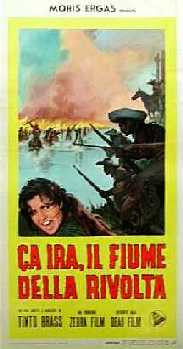
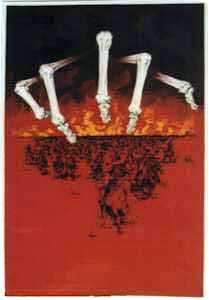
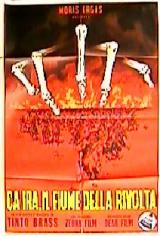
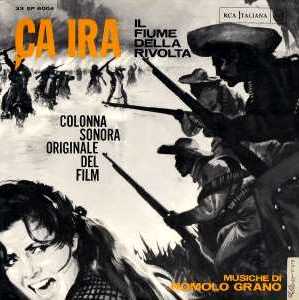
Lorenzo Nistri’s poster design (Reproduced courtesy of the Painted Cinema)
After a wait of 33 long years I have finally been able to see this movie.
It’s quite difficult to sum up.
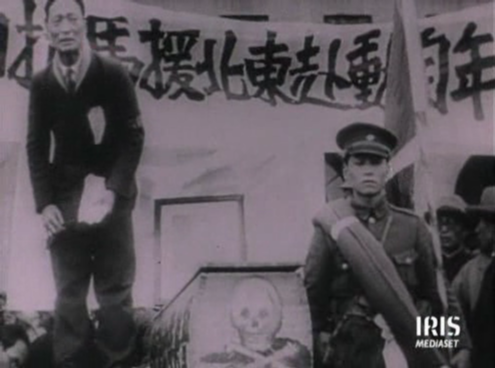
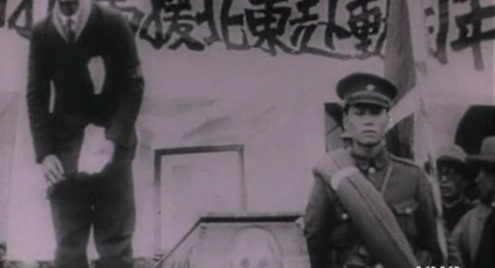
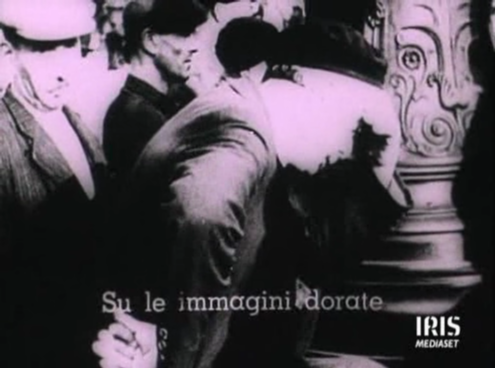
It uses an enormous amount of footage from other films, mostly newsreels,
to make a point about civilization, namely, that civilization is based upon violence,
and that we need to rethink everything if in the future we decide to be helpful rather than destructive.
It opens with a space flight, with the narrator saying that it is easier for humans to go to the moon than to overcome injustice.
That’s a sad statement, but arguably true.
It accords with anthropologist Stanley Diamond’s assessment that
“Civilization begins with conquest abroad and repression at home.”
It accords with Oriani Fallaci’s statement that
“Whether it comes from a despotic sovereign or an elected president,
from a murderous general or a beloved leader,
I see power as an inhuman and hateful phenomenon....
I have always looked on disobedience toward the oppressive
as the only way to use the miracle of having been born.”
And now that, after a 33-year-long wait, I have finally been able to watch this movie multiple times,
I can at last understand why some critics reacted in their off-handed way, dismissing the movie’s arguments
as simplistic, glib, pompous polemics.
Their jobs depend upon maintaining the status quo,
and to sing praises to arguments such as the ones this movie makes
would jeopardize their positions.
So they were required to misrepresent it as Communist bombast or as pro-revolutionary propaganda,
even though the movie was exactly the opposite.
The critics succeeded in their goal of discouraging people from attending.
Some who tried to appear to be fair put on a show of being courteous while giving the movie backhanded compliments.
Yes, it is true, as they said, that the movie’s arguments are simplistic:
Violence is wrong. Killing is wrong. Murder is wrong. War is wrong. Political power is wrong. Obedience to authority is wrong.
Those are simplistic arguments — and I agree with them wholeheartedly.
I don’t think that in my entire life so far I have met even a dozen people who agree with any of those simplistic arguments.
Almost everyone I have ever met would laugh off such statements as silly, facetious, and unrealistic.
The film is almost certainly censored.
Every atrocity shown on screen is an atrocity committed by the right.
Yet there are hints, in both the visuals and the commentary,
that indicate that, in the original form, the film also presented atrocities committed by the left.
I assume that the censors are responsible for some significant deletions.
The original running time was listed as 110 minutes, but the current version runs 93 minutes.
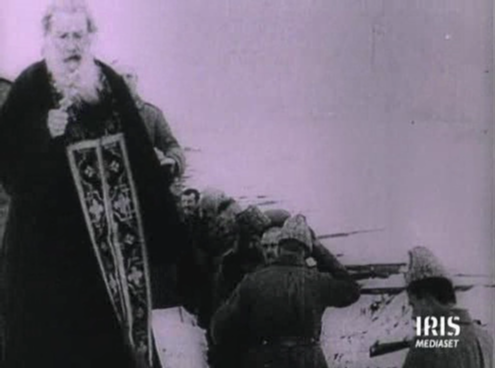
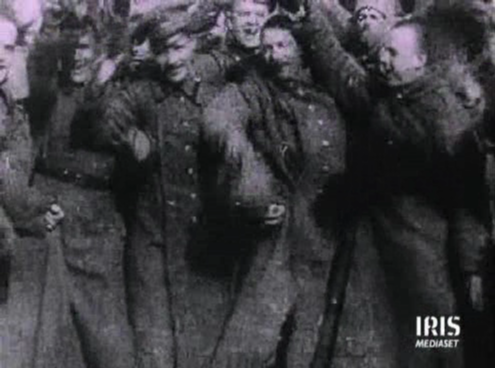
I must say that this movie contains more harrowing images than I wish to count.
The executions and mutilated corpses that fill half the running time can be too much for many people to take.
What makes it even more disturbing is that it borrows Abel Gance’s editing style,
which was a double-edged sword.
The editing is so beautiful, enrapturing, compelling, exciting, and downright entertaining
that we find ourselves enjoying it, even as the images that are being edited are of atrocities.
It makes the film easier to watch, because it dilutes the horrific impact of the images,
but it makes it harder to watch, because we feel guilty for enjoying the rhythms.
I could not have handled this movie in my teens or twenties.
I would have given up after a few minutes and then suffered years of nightmares.
Now, though, I can take it.
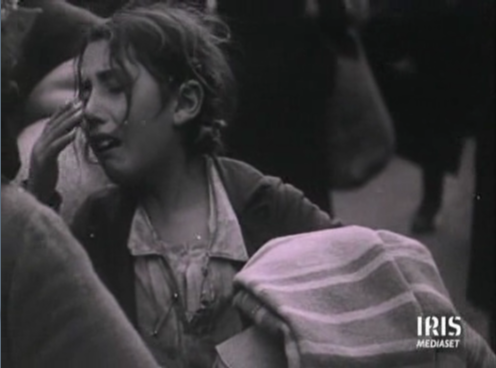
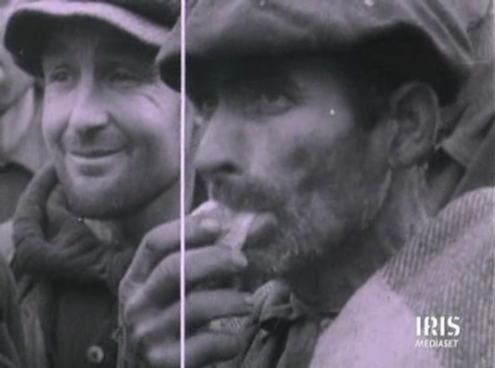
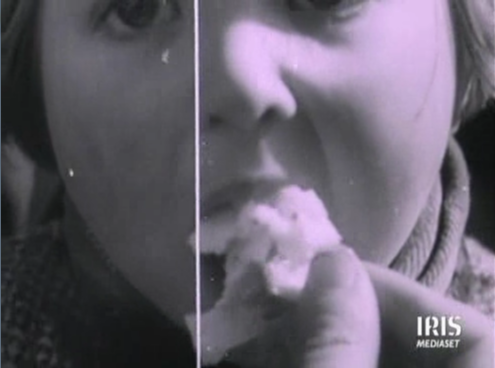
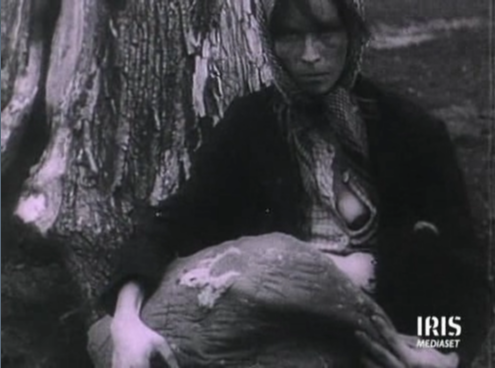
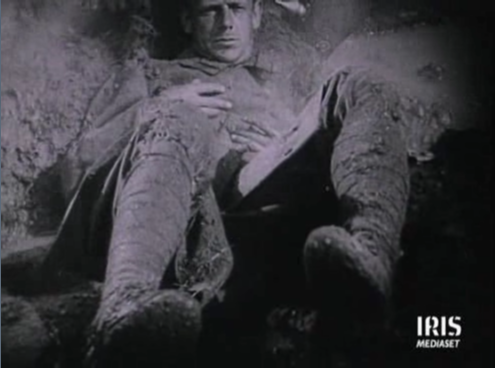
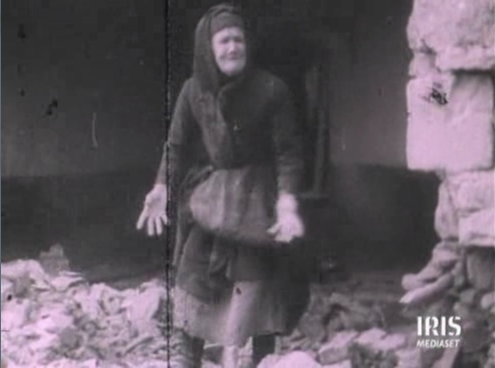
On a personal note, I may also say that this movie contains one particular image
that has haunted me since 1984 when I first saw it reprinted in Salon Kitty.
It is from Spain, it is surely a newsreel, and it occurred seemingly during the mass exile
after the destruction of the International Brigade’s Knights of Zero.
To my dying day I shall never forget this image, for it is heartbreaking:
This movie began while Tinto Brass was working on Roberto Rossellini’s
Il Generale della Rovere.
Rossellini had hired Tinto as an assistant director,
but tempers on set were so volatile that Tinto offered instead to do research at the Cinémathèque Française
to locate suitable archival footage for intercuts and optical backgrounds.
He was surprised to discover that the Cinémathèque had a wealth of footage on numerous wars from 1900 on,
most of it unknown and unseen.
He approached producer Moris Ergas
about making a feature on twentieth-century revolutions.
Ergas agreed, and Brass spent 1962 through 1964 hammering the countless little clips together.
It was not until after his next film, In capo al mondo
(a.k.a. Chi lavora è perduto)
that he completed the editing and brought along Franco “Kim” Arcalli and the well-known Giancarlo Fusco to write the narration.
They finished the film, Ça ira, il fiume della rivolta (Ça ira, the River of Revolt)
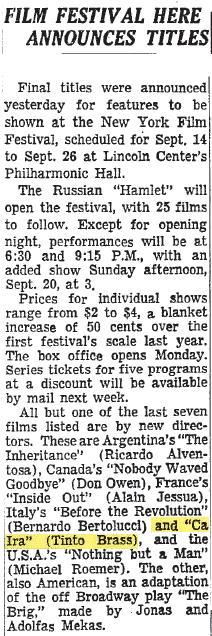
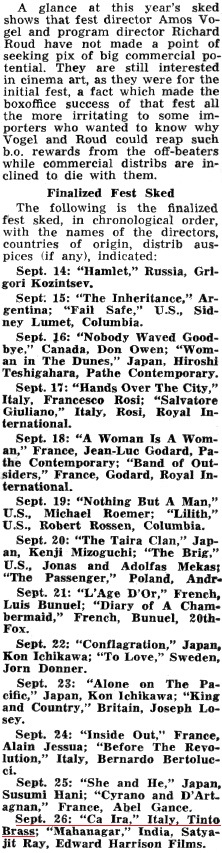
had already been booked for the first New York Film Festival even prior to its world-première screening
at the Venice Film Festival on Sunday, 6 September 1964.
It got a mixed but mostly positive reception.
Let’s follow the scrambled story as best we can:
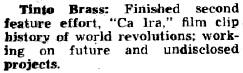
“Current Credits of Italo Directors,” Variety, Wednesday, 29 April 1964, p 82:
The New York Times (Friday, 28 August 1964, p 19):
The New York Times, Sunday, 30 August 1964, Drama p 7:
Vincent Canby, “Lincoln Center’s ‘Love Fest’: Industry Roots N.Y. Conclave,”
Variety, Wednesday, 2 September 1964, pp 3, 16:
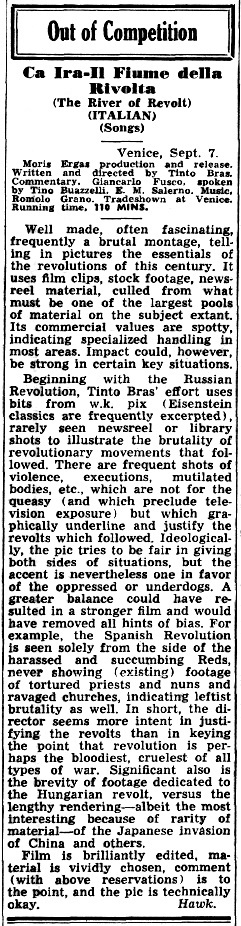
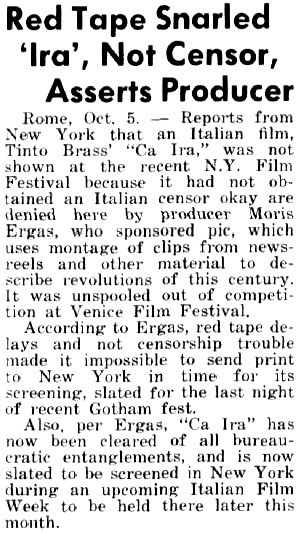
Variety, Wednesday, 16 September 1964, p 22:
(I’m compelled to say that “Hawk” was probably too overwhelmed by the ferocious images
to pay sufficient attention to the commentary.
There is no attempt to justify any violence.
To explain, yes, but never to justify.
Ça ira is clearly opposed to all violence, whether from the right or from the left or from any faction.
The new government is inevitably a Xerox copy of the old, utilizing the same brutality all over again.
That’s the point of the movie.
You’re probably wondering what “w.k. pix” means, yes?
It’s typical Variety slang that means — hold your breath —
“well-known motion pictures.”)
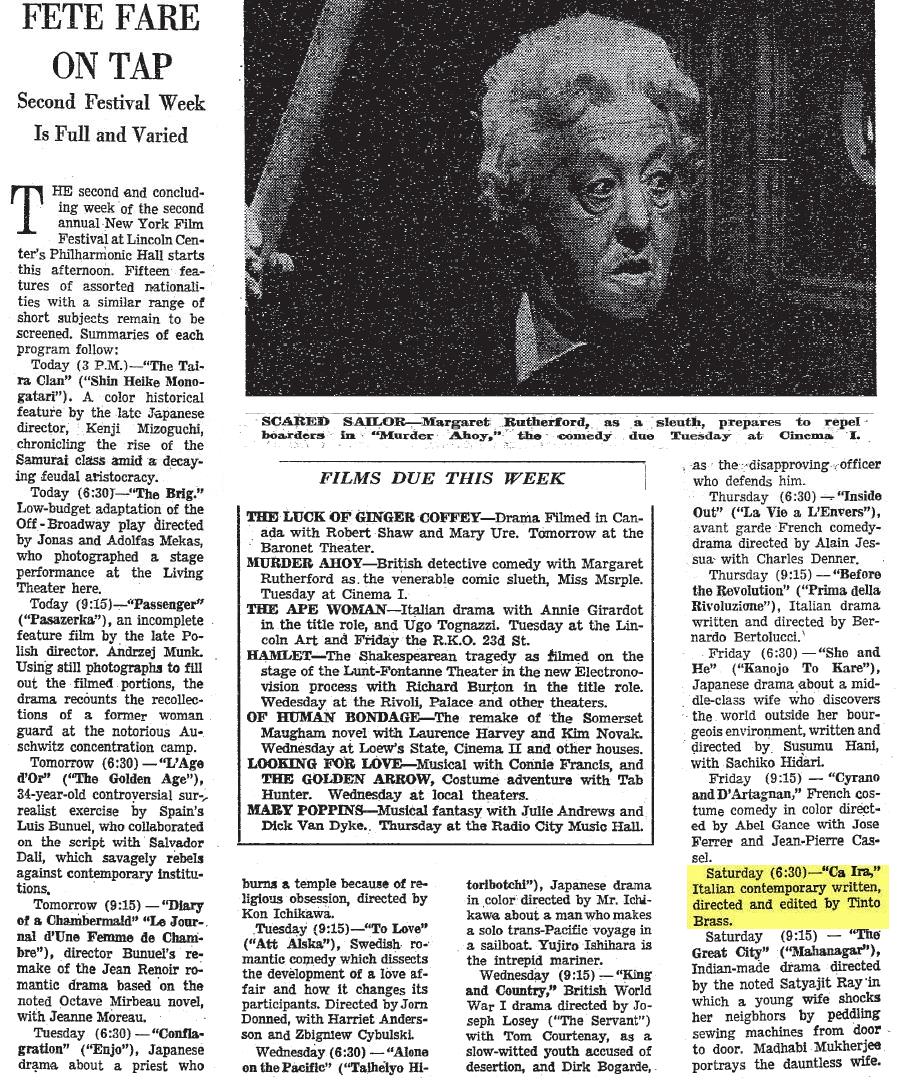
The New York Times (Sunday, 20 September 1964, p X11):
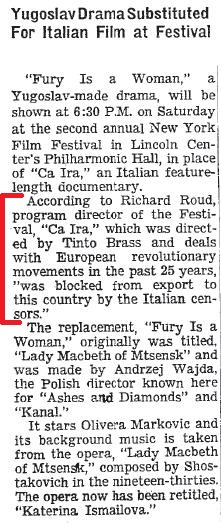
The New York Times (Tuesday, 22 September 1964, p 45):
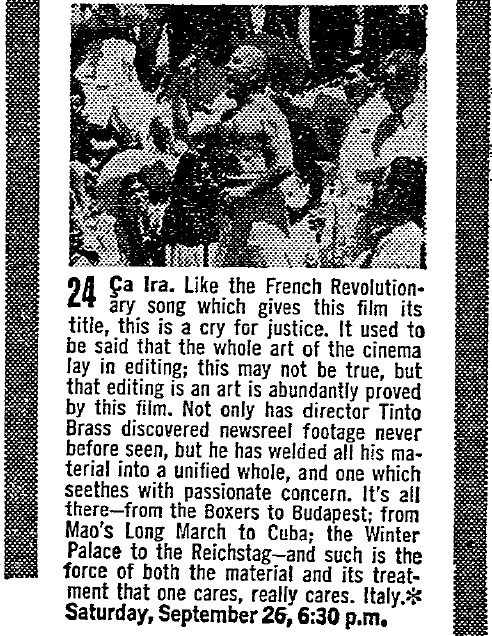
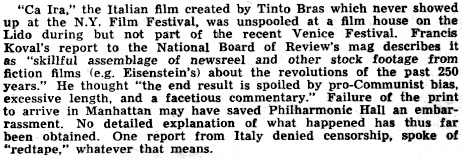
“Venice 1964,” Films in Review, October 1964, p 462:
September 6. This was supposed to be a “day of rest” —
there are no official screenings —
but by eleven this morning an enormous crowd had queued in front of one of the Lido’s shoddier cinemas
to see a feature-length documentary by the would-be Italian avantgardist, Tinto Bras,
called Ca ira, il Fiume della Rivolta (River of Revolt).
It is a skillful assemblage of newsreel and other stock footage, and clips from fiction films
(e.g., Eisenstein’s), about the revolutions of the last 250 years.
Some of the footage has not often been seen, and some of it is quite interesting.
But the end result is spoiled by pro-Communist bias, excessive length, and a facetious commentary.
(Despite frequent claims, Ça ira is anything but a documentary.
It uses archival footage, but that doesn’t make it a documentary at all.
It’s an editorial.
When you see it, you’ll know what I mean.)
Daily Variety, Tuesday, 6 October 1964, p. 6:
“Inside Stuff — Pictures,” Variety, Wednesday, 14 October 1964, p 15:
Esquire (February 1965):
Ça Ira (Tinto Brass) :
this two-hour mélange of stills, newsreel clips and excerpts from movies by Eisenstein and others
was subtitled when I saw it last fall in Venice, “Il Fiume della Rivolta,”
and it pretends to be a documentary about revolutions.
In fact it is a sensationalistic exploitation of Congo massacres,
Chinese butcheries,
Algerian tortures,
Nazi death camps,
Latin-American executions
and other horrors of our century,
all botched together with a few stabs at arty montage
and all very tedious unless one is a necrophile.
The Mondo Cane of revolution.
The movie seems finally to have been released in Italy on 3 December 1964,
maybe with some censor cuts, but I’m not sure.
I have not seen the boxoffice figures, but I am led to understand that it earned its money back and made a small profit.
It played at only a few venues, as far as I know, and only briefly.
This was clearly a source of deep frustration for Tinto.
I suspect that of this is probably one of his favorites of his own films — and yet almost nobody ever saw it.
In later films he would re-use clips from Ça ira,
as though he were desperate for audiences to see at least little glimpses of it.
Ça ira is the defining work in Tinto’s opus.
It is his strongest and most vociferous statement in favor of personal freedom and against all authority figures.
Every film he would make afterwards would use the sentiments of this first feature as a foundation,
and that includes even his silliest and fluffiest sex comedies,
which he made partly for the money, partly to reach a broader audience, and partly as an erotic antidote to instinctual violence.
Nowadays Ça ira is occasionally broadcast on Italian television.
Next time it airs, please record it for me and
I’ll buy it from you! Thanks!
(The copy I found on the Internet is very low quality. I’d like something at a higher resolution.)
The story gets even more interesting in 1969 :
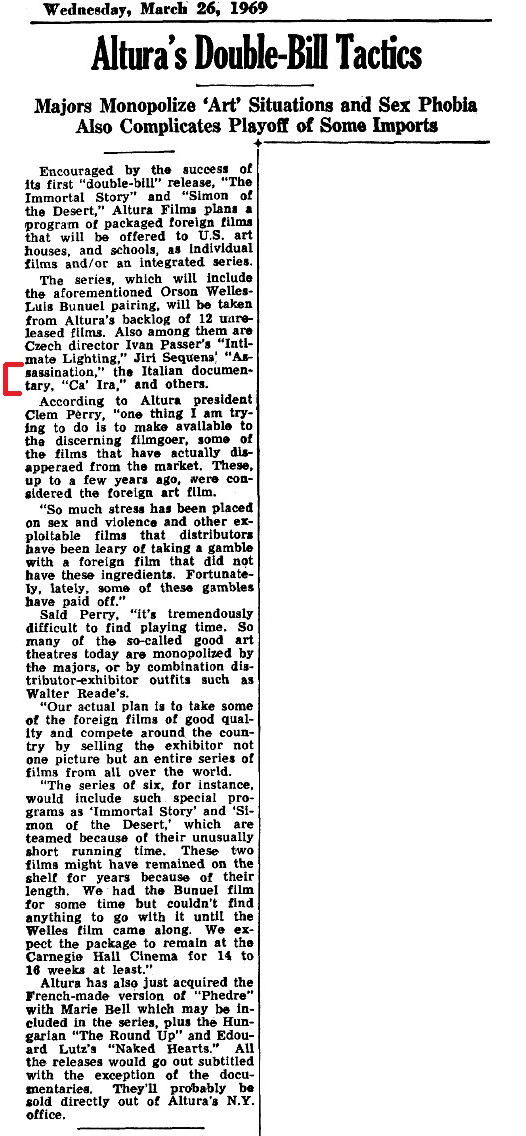
Variety, 26 March 1969, p 35:
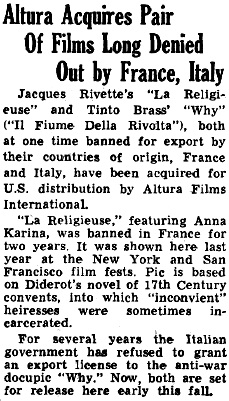
Variety, 10 September 1969, p 6:
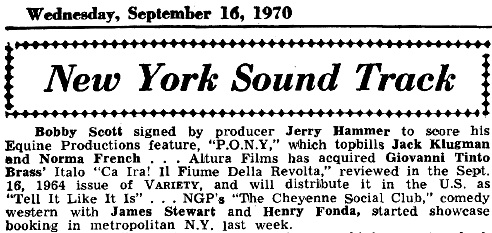
“New York Sound Track,” Variety (weekly, 16 September 1970):
This calls for some comment.
Altura was an independent New York-based film distributor
founded by Clem Perry,
who had been enamored of Brass’s film.
Perry himself was an interesting character,
who had released numerous foreign films, notably those of Luis Buñuél,
but only after modifying them for American tastes.
A friend of his emailed me and said that what many critics praised
as Buñuél’s distinctive artistry was actually the work of Perry.
Though the proposed US title was Tell It Like Is Is, it was released as Thermidor.
It was a slightly modified edition of the movie. The narration was translated into English, with only the smallest changes here and there.
Normally I resent it when producers and distributors modify movies
(an exception to that rule, of course, is what Woody Allen did with
International Secret Police: Key of Keys, which he converted into What’s Up, Tiger Lily? —
which I understand has been considerably sanitized in recent years, unfortunately).
But I think I’d make an exception for Thermidor.
Clem Perry put a lot of love into making a US version.
Tinto is apparently not impressed with it, but I don’t think he’s upset either.
Anyway, just look at the folks who participated in making it:
French novelist/playwright Ursule Molinaro,
professor of Italian literature Letizia Brod,
poet and New York Quarterly founder William Packard,
publisher/reviewer/translator Harold Salemson,
actor/director Ben Gazzara,
actor/co-founder of the American Place Theater Michael Tolan,
prominent stage actress Irene Worth,
and actor/director/professor Al Freeman Jr.
This is not a typical producer/distributor’s botched rescue job.
There are a few other names in the credits too.
For instance, Bernard Sznycer must be the Bernard W. Sznycer who translated a Chekhoff play.
He was the husband of musical performer Katharine Sergava.
There’s also Lou Burdi. I couldn’t learn anything about him for the longest time,
but now his credits are on IMDb.
He did sound effects for the US-release editions of the softcore Greek
Hot Month of August
and Cambist’s chopped-downsexed-up version of
The Minx.
His later movies seem all to be sex stuff.
Very strange. Well, it’s a job, I guess, and it pays, I hope.
If you want to judge him on it, well, think a moment: Do you like your job? Do you want people to judge you by your job?
Interestingly, Thermidor was possibly the only one of Brass’s films
that the Catholic Church ever praised, calling it
“a powerful message on the side of peace”
(Catholic Film Newsletter 36, no. 17, 15 September 1971, p 86).
Thermidor premièred on 24 August 1971 at the 5th Avenue Cinema in Manhattan,
and the advertisement was never more detailed than the one below.
As you will see, it played at a Rugoff cinema, surely because Clem Perry was a Rugoff executive.
It played for only one week and I know of no other commerical venues that presented it, ever.
As with the original version, this new edition also received mixed comments.
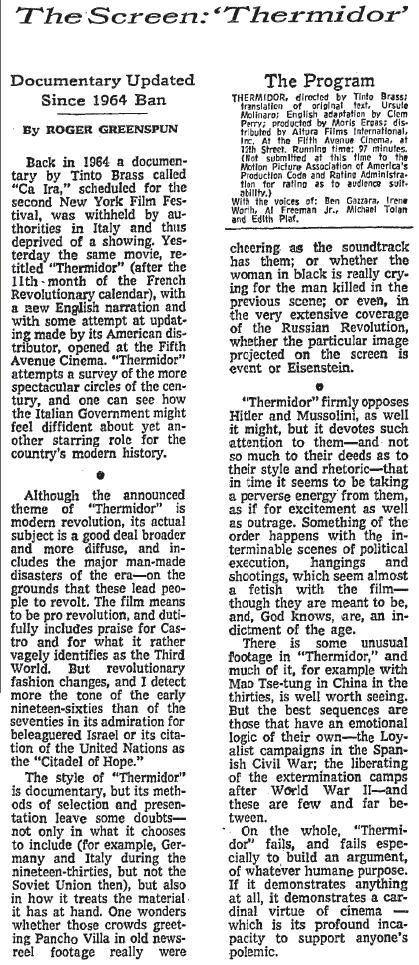
The New York Times (Wednesday, 25 August 1971, p 45):
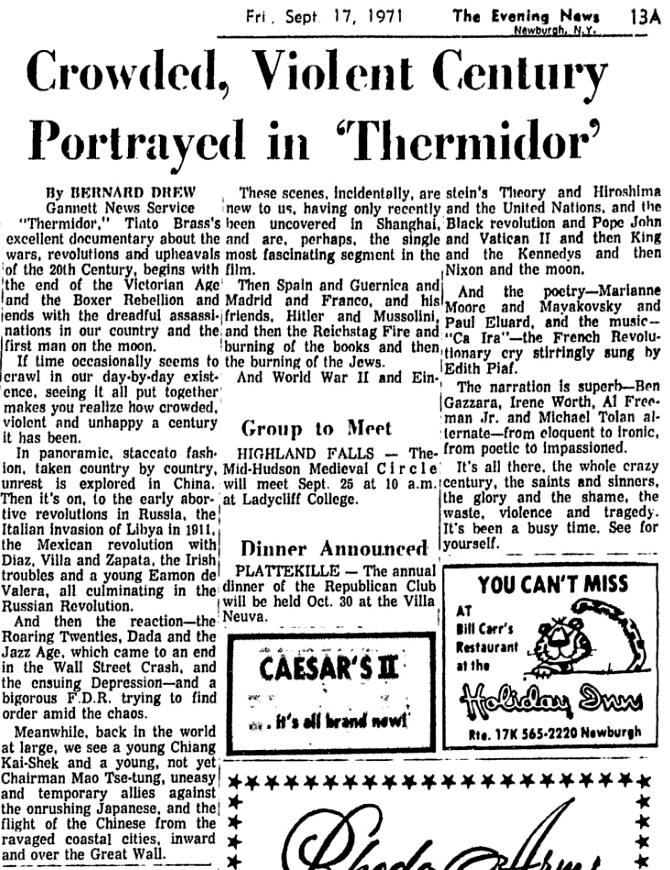
Cue (28 August 1971):
THERMIDOR(Altura) At the Fifth Avenue Cinema.
Care to take a look at the devastation man has wrought in the 20th century?
I find historical film clips fascinating even when they turn my stomach.
Tinto Brass created a documentary in Italy stressing the unremitting violence of the last 70 years,
and Clem Perry has produced an American version.
You can watch history speed by, punctuated by executions, wars, extermination, assassinations, and atomic bombing.
You may find brighter horizons at seeing Man shake his environment by landing on the moon.
The narration is a glib, pompous concoction of commentary and poetry.
Ben Gazzara, Irene Worth, Al Freeman, Jr., and Michael Tolan try to make it come to life,
but the talk, straining to be profound, is merely precious.
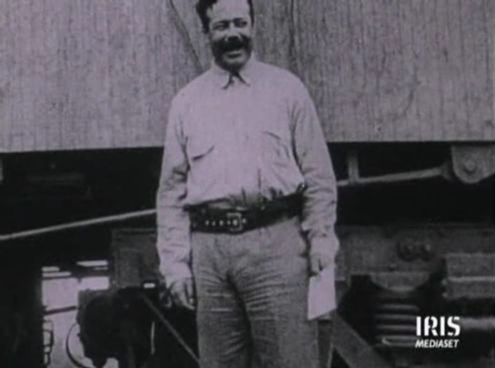
However, the sights and sounds are there, and so are the people — Villa, Rosa Luxemberg [sic],
Franco, Hitler, Roosevelt, Einstein, Mao, et al.
Thermidor is an intriguing cauldron of the world’s preoccupation with destruction.
It’s amazing that Thermidor was so instantly forgotten, considering who narrated it!
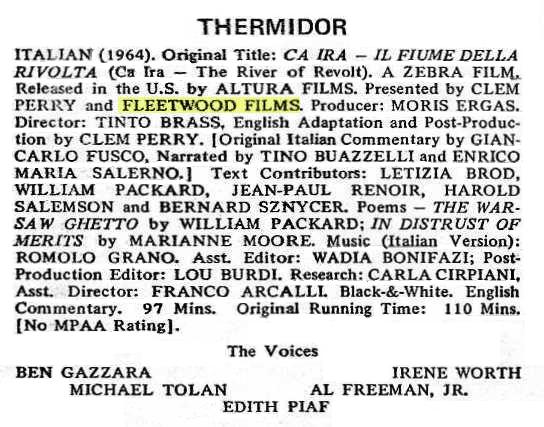
As we can see from the credit listing,
Altura was associated with Fleetwood Films:
Film Facts (1971, p 515):
Altura has long been defunct,
but its associated company, Fleetwood Films, which took presentation credit,
was owned by Crowell Collier and Macmillan, as we learn from this article:
The New York Times (Monday, 15 July 1968, p 45):
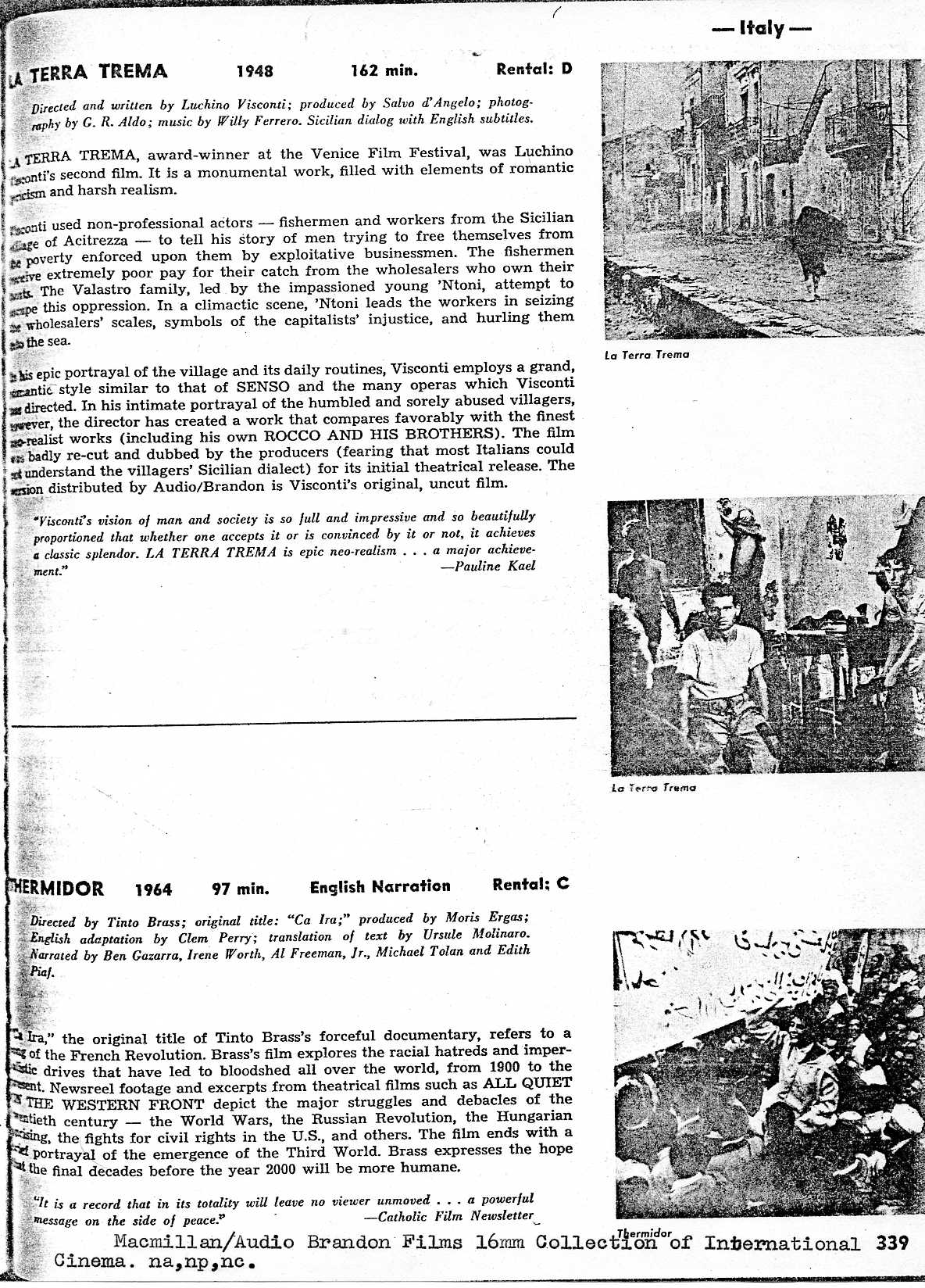
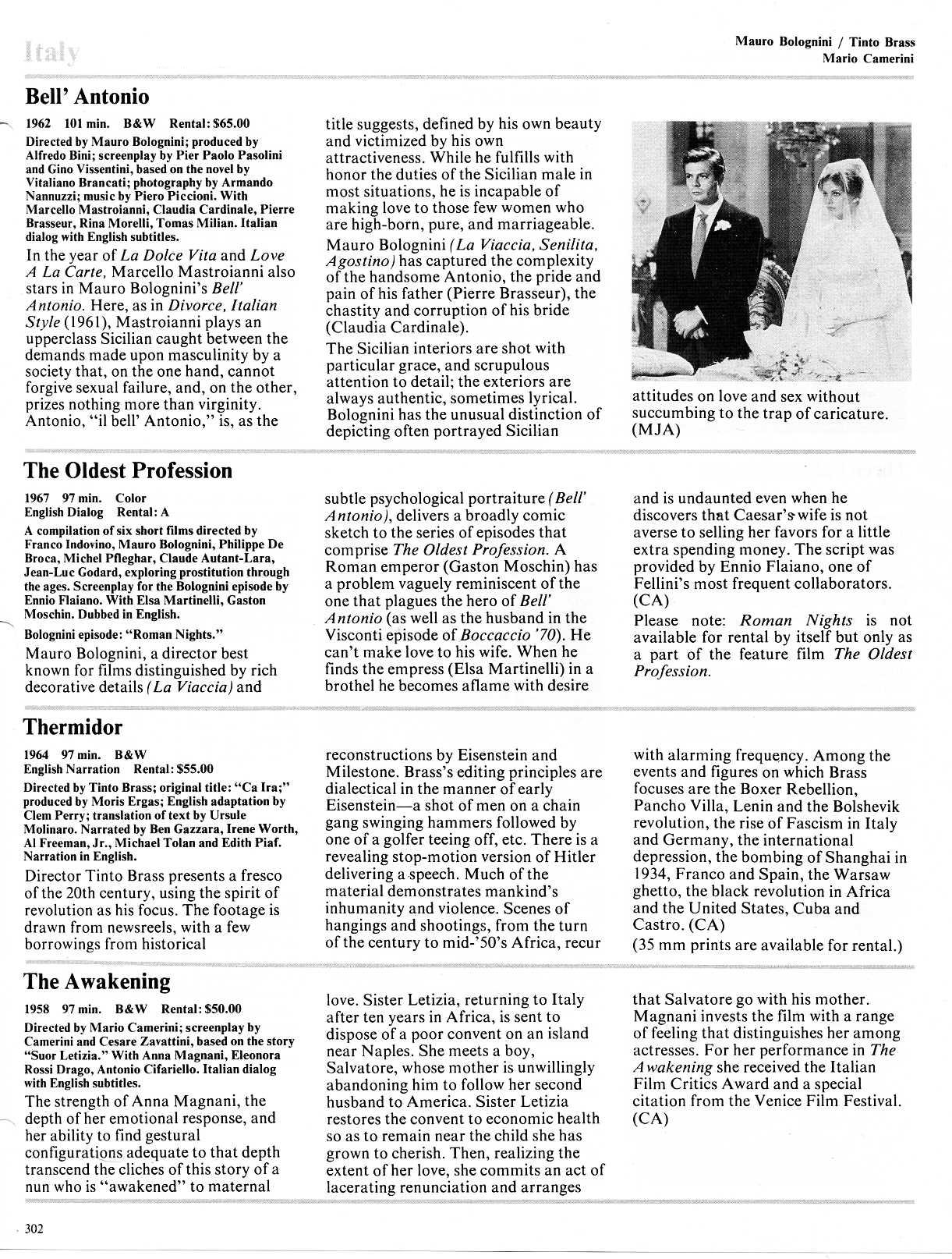
Hence the license for Thermidor went to Macmillan/Audio-Brandon:
A photocopy of a page from an undated Macmillan/Audio-Brandon 16mm Film Catalogue:
A page from the 1978/1979 Audio-Brandon 16mm Film Catalogue:
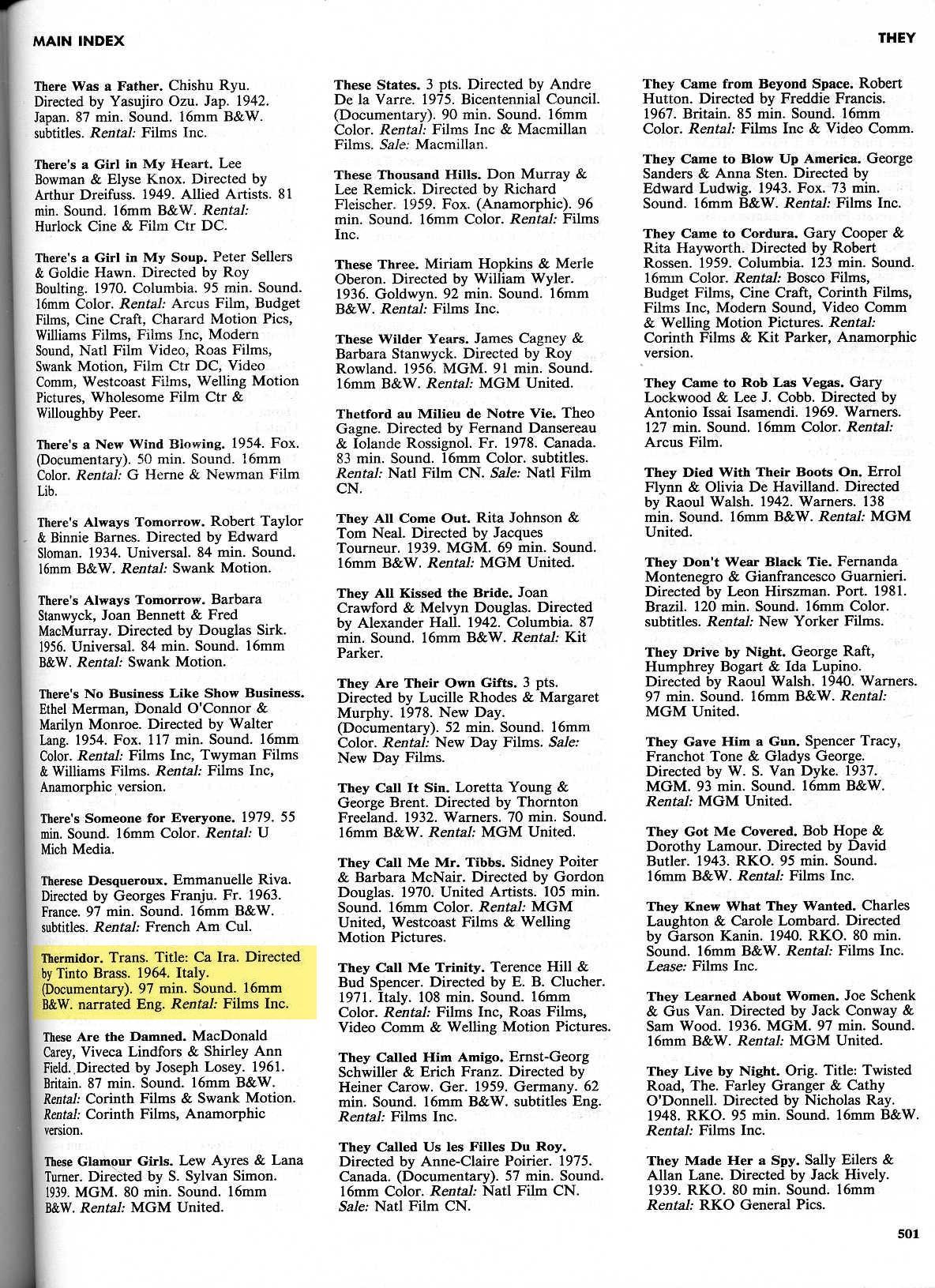
This is one of those invaluable resources that would bore the skin off your teeth:
James L. Limbacher, compiler, Feature Films:
A Directory of Feature Films on 16mm and Videotape Available for Rental, Sale, and Lease, 8th ed
(New York &: London: R R Bowker Company, 1985):
In 1997 Films Inc got out of the film business and switched exclusively to video,
and all of its remaining film materials went to Kit Parker,
but by that time Films Inc no longer retained its license to Thermidor.
(Kit Parker shortly afterwards likewise abandoned film in favor of video,
and many of the remaining prints ended up at the New York Public Library,
where, last I heard, the massive job of cataloguing the collection had years yet to go.)
What must have happened is that the film was never even once rented to anybody.
The prints were discarded or misplaced, and the listings continued only because the proofreaders never caught the discrepancy.
Once the US license expired, whenever that was, and it could have been any time between 1972 and 1997,
all the known materials were packed up back to Italy.
But where in Italy?
We are offering a bounty for a good video of Thermidor.
If you know where we can get one, or if you know where the prints and/or materials are located,
write to us.
Thanks!
GIANCARLO FUSCO, the noted author and boxer, wrote the commentary for the film.
He and Brass would team up five more times over the next 17 years.
Once their collaborations ended, Brass’s films would never be the same again.
Once upon a time, a site called Il pacifico, located at
http://www.memoriale.com/1974mem.htm,
posted this photo of Giancarlo Fusco, who looks
rather like a certain American president, yes? But I
don’t think this is our Giancarlo Fusco.
(If you know who this really is, and/or if you know who owns
the rights to this photo, please
contact me. Thanks!)
On the other hand, I think this is truly the Giancarlo Fusco in question.
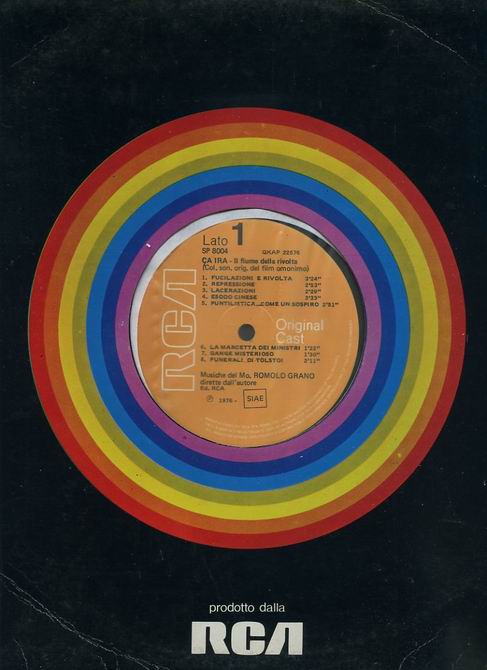
The unreleased soundtrack LP, RCA SP 8004. It seems that only a few were pressed for a select few VIPs.
Nonetheless, tracks from this LP reappeared on other LPs, as we can see from this interesting web site: http://masasaruyoppitako.web.infoseek.co.jp/RCA_SP10000.html.
IF YOU WANT TO LEARN THE FRENCH REVOLUTIONARY HYMN “ÇA IRA”
(SUNG BY EDITH PIAF, NO LESS!), TUNE IN TO:
Modern History Sourcebook
Here’s
“La ninna nanna de la guerra” sung by Edmonda Aldini
(I have trouble enough with standard Italian; this is, I presume, the Roman dialect, which makes my head spin):
Ninna nanna, pija sonno
ché se dormi nun vedrai
tante infamie e tanti guai
che succedeno ner monno
fra le spade e li fucili
de li popoli civili
de la gente che se scanna
per un matto che commanna;
che se scanna e che s’ammazza
a vantaggio de la razza
e a profitto de una fede
per un Dio che nun se vede,
ma che serve da riparo
ar Sovrano macellaro.
Ché quer covo dassassini
che c’insanguina la terra
sa benone che la guerra
è un gran giro de quatrini
che prepara le risorse
pe li ladri de le Borse.
Fa la ninna, cocco bello,
finché dura sto macello:
fa la ninna, ché domani
rivedremo li sovrani
che se scambieno la stima
boni amichi come prima.
So cuggini e fra parenti
nun se fanno comprimenti:
torneranno più cordiali
li rapporti personali.
E riuniti fra de loro
senza l’ombra del rimorso,
ce faranno un bel discorso
su la Pace e sul Lavoro
pe quer popolo cojone
risparmiato dar cannone!
Sleep my little one and I will sleep and then we will not see all the evil and the violence that is sweeping across our world
Sharp cold bayonets on rifles which civilised people stick into their choking victims at the whim of their mad leaders
Those who choke and those who kill have sold out on their rich past they profit from a blind faith in a god whom no one sees
why try to fight back why try to resist what these assassins are doing spilling our blood on our soil
Everyone knows that war is a game played with money all our precious possessions are wasted by these pickpockets
Be still my little one while all this killing goes on be still and we may wake to a saner world tomorrow
And if things get better and we still have our friends among cousins and parents one can always be kind
Then everything will be happier friendships will be warmer
There will be love among people there will be no more sadness
That is a good plan for life to live in peace and decent work and as for the evil leaders we will take away their guns
Marcel Mouloudji’s adaptation of Boris Vian’s lyrics of Arthur Rimbaud’s poem, “Le déserteur” with music by Harold Berg (1954):
AS SUNG IN THE RECORDING
TRANSLATION
AS IT IS EDITED IN THE MOVIE
US SUBTITLES
Messieurs qu’on nomme Grands Je vous fais une lettre Que vous lirez peut-être Si vous avez le temps
You men with great names! This is a letter That maybe you will read If you can spare the time.
Signori dai grandi nomi Vi scrivo una lettera Che forse leggerete Se ne avrete il tempo
You men with great names! this is a letter to you which maybe you will read If you can spare the time.
Je viens de recevoir Mes papiers militaires Pour aller à la guerre Avant mercredi soir
I’ve just received My call-up papers To leave for the front Before Wednesday night.
Messieurs qu’on nomme Grands Je ne veux pas la faire Je ne suis pas sur terre Pour tuer des pauvres gens
You men with great names! I do not want to go I am not on this earth To kill poor people.
C’est pas pour vous fâcher Il faut que je vous dise Les guerres sont des bêtises Le monde en a assez
I do not wish to offend you, But I must tell you Your wars are criminal And the world has had enough.
Non per offendervi ma bisogna che vi dica La guerre son bestialità il mondo ne ha abbastanza
I do not wish to offend you, but I must tell you your wars are criminal and the world has had enough.
Depuis que je suis né J’ai vu mourir des pères J’ai vu partir des frères Et pleurer des enfants
Since I was born I have seen brothers die, I have seen fathers leave, I have seen children cry.
Da quando sono nato ho visto morire dei fratelli ho visto partire dei padri e piangere dei bambini
Since I was born I have seen some brothers die, I have seen some fathers live [sic], I have seen some children cry —
Des mères ont tant souffert Et d’autres se gobergent Et vivent à leur aise Malgré la boue le sang
Mothers have suffered so much And others are mocking And living at ease Despite the mud the blood
Il y a des prisonniers On a vole leur âme On a vole leur femme Et tout leur cher passé
There are prisoners We steal their souls We steal their wives And all their cherished past
Ci sono i prigionieri son state rubate le loro anime son state rubate le loro donne e tutto il loro caro passato
and I have seen the prisoners, you have taken away their souls, you have taken away their women, you have taken away their birthright.
Demain de bon matin Je fermerai ma porte Au nez des années mortes J’irai par les chemins
Tomorrow at daybreak I will lock my door. In the face of the dead years. I will go onto the roads.
Domani di primo mattino chiuderò la mia porta siamo delle anime morte e me ne andrò per le strade
Tomorrow at daybreak I will lock my door. Our souls are all dead. I will go out onto the roads
Je mendirai ma vie Sur la terre et sur l’onde Du Vieux au Nouveau Monde Et je dirai aux gens:
I shall beg for the rest of my life, Through the earth and over the waves, From the old world to the new, And I will tell all the people
Mendicherò la mia vita Sulla terra e sulle onde dal vecchio al nuovo mondo e dirò alla gente
and beg for the rest of my life, through the earth and over the waves, from the old to the new world, and I will tell all the people
Profitez de la vie Éloignez la misère Nous sommes tous des frères Gens de tous les pays
Enjoy Life Stay away from misery We are all brothers People from all countries
approfiattate delle vite allontanate la miseria siamo tutti dei fratelli genti di tutti i paesi
you are destroying their lives, we are all of us brothers, the people of all countries.
S’il faut verser le sang Allez verser le vôtre Messieurs les bon apôtres Messieurs qu’on nomme Grands
If someone has to shed his blood, Why don’t you shed yours — Yes, all you great good apostles, Yes, all you men with great names.
Se bisogna versare il sangue andate a versare il vostro signori buoni apostoli signori dai grandi nomi
If someone has to shed his blood, why don’t you shed yours — yes, all you great good apostles, yes, all you men with great names.
Si vous me poursuivez Prévenez vos gendarmes Que je n’aurai pas d’armes Et qu’ils pourront tirer Et qu’ils pourront tirer...
And if you chase me, Tell all your policemen That I do not have any weapons, And so they can shoot me, And so they can shoot me.
se voi mi inseguite avvisate il vostri gendarmi che io non avrò armi e che essi potranno spararmi e che essi potranno spararmi
And if you chase me, tell all your policemen that I do not have any weapons, and so they can kill me, and so they can kill me.
There are several other archival songs included, such as
“The Rising of the Moon,”
and “Giovinezza,”
but I can’t find the particular recordings used in the movie.
The recording of “Inno dei giovanni fascisti”
is on the Internet, though.
There’s also a Spanish fandango that I haven’t a clue how to identify.
Ditto for other archival recordings, such as a nationalist hymn that seems to be Spanish and another that seems to be Spanish Communist.
Okay, call me a dunce, but I really don’t recognize them, except, of course, for
“Le chant des partisans.”
World première Sunday, 6 September 1964, out of competition at
the Venice Film Festival
Italian release scheduled for Thursday,
3 December 1964
Distributed by Dear
DISPUTE ABOUT THE RUNNING TIME:
Claimed running time of Venice Film Festival version: 110 minutes
Claimed length of
version approved by ANICA on Tuesday, 15 September 1964: 2,652m = 8,700'+13frames = 96min41sec
(censor visa # 43676)
Claimed running time of release version: 94 minutes
Confirmed running time of TV version: 92 ½ minutes (24fps) or 89 minutes (25fps),
but it begins and ends abruptly, indicating that it was at least several seconds longer originally;
the TV version is also missing the part titles (FINE PRIMA TEMPO and SECONDO TEMPO),
which would have occupied another ten seconds or so
Needs to be shown at 1:1.375,
but the Italian subtitles for the non-Italian portions were high enough that they would fit at a 1:1.85 crop.
So I strongly suspect that this film was always and only shown at 1:1.85 at cinemas, which would have been disastrous, to say the least.
I wouldn’t even be surprised if the prints came with instructions to the projectionists to run it at 1:1.85.
Does anybody know for sure? If you do, please contact me. Thanks!
You know, people get so mad at me — fuming, shouting, screaming mad — when I gripe about cropping.
They have no idea what I’m talking about, they don’t see anything wrong, and they just want me to shut up already, for crying out loud.
Cinema owners and managers evict me from their establishments when I mention the problem, and they threaten to call the police.
Well, okay, once and for all, observe the table below.
The original film image is on the left, and the result when shown at “widescreen” at a cinema is on the right.
Look at it, and if you still don’t see anything wrong, please never talk to me as long as you live:
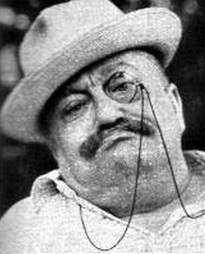
Sandra Milo (producer Ergas’s mistress at the time — if you want to increase your movie’s chances of success, you must hire the producer’s mistress, always) (11 Mar 1935 – )
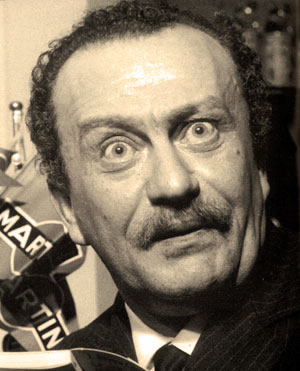
Tino Buazzelli (13 Sep 1922 – 20 Oct 1980)
Enrico Maria Salerno (18 Sep 1926 – 28 Feb 1924)
Though I have never seen the US version, I have learned some things about it,
and these are the most significant differences between the Italian TV version and the US version that I know about:
• The US edition has an added prologue, in which Marianne Moore’s poem
“In
Distrust of Merits” is spoken.
I don’t know if any visuals accompanied this, or if it was done against a blank screen.
• The struck verses below are deleted from the US version:
LIBERTY
On my exercise book On my desk and the trees On the sand on the snow I write your name
On all the pages read On all the white pages Stone blood paper or ash I write your name
On the golden images On the warriors’ arms On the kings’ crown I write your name
On the jungle and the desert On the nest on the broom On the echo of my childhood I write your name
On the wonders of the nights On the white bread of the days On the seasons engaged I write your name
On all my rags of azure On the pond mildewed sun On the lake live moon I write your name
On the fields on the horizon On the wings of the birds And on the mill of the shadows I write your name
On every puff of dawn On the sea on the boats On the mad mountain I write your name
On the moss of the clouds On the sweat of the storm On the rain thick and tasteless I write your name
On the paths awakened On the roads spread out On the squares that overflow I write your name
On the scintillating figure On the bells of the colors On the physical truth I write your name
On the paths awake On the roads unfurled On the squares overflowing I write your name
On the lamp that lights On the lamp that goes out On my houses reunited I write your name
On the fruit cut in halves Of the mirror and of my room On my empty shell bed I write your name
On my dog greedy and gentle On his ears cocked On his clumsy paw I write your name
On the springboard of my door On the familiar objects On the flood of the blessed fire I write your name
On any granted flesh On my friends’ brow On every hand held out I write your name
On the window of the surprises On the attentive lips Well above the silence I write your name
On my destroyed refuges On my collapsed lighthouses On the walls of my boredom I write your name
On the absence without desire On naked solitude On the steps of death I write your name
On health returned On the risk disappeared On hope without memory I write your name
And by the power of a word I recommence my life I am born to know you To name you...
Liberty.
• Beginning at about 1:03 (video speed) or 1:06 (cinema speed)
an archival recording of a Jewish lament about the extermination camps is replaced (or overlaid?)
by William Packard’s poem,
“The Warsaw Ghetto.”
(If you can identify the original lament, please write to me. Thanks!)
• A few phrases of the final lines of commentary are altered.
“Free even physiologically” is changed to “Free even psychologically.”
The following verse is shortened, as per the strike-through:
Science travels relative but infinite roads.
Which go from the visible to the invisible.
They rise up from the guts of man.
From the heart. They rise up from the red blood globules,
they rise up from the cells.
To compensate for the loss, a superimposed title is added at the end:
THE ROAD TO PEACE — FREEDOM AND DIGNITY
• The end credits are no longer white letters against a black background,
but are instead against a split-screen montage.
Or, possibly, they are on a neutral background, while a montage occupies the other half of the screen.
• There seems to be an epilogue, possibly during the closing credits, or possibly afterwards,
consisting of brief quotations from Ralph Waldo Emerson, John B. Watson, Aristotle, H.G. Wells,
Benjamin Franklin, and Booker T. Washington.
Clem Perry and
Fleetwood Films present
Thermidor
Distributed by
Altura Films International, Inc.
Released on Tuesday, 24 August 1971
Claimed running time that I entirely fail to believe: 97 minutes